Checkout using your account
Checkout as a new customer
Creating an account has many benefits:
Reviewed By
Tyre Specialist, Tire.ae
Mohammad Mahmoudi is the Operations Manager at Tire.ae, helping customers choose the right tyres for their vehicles. He ensures professional fitting services and a reliable experience across the UAE.
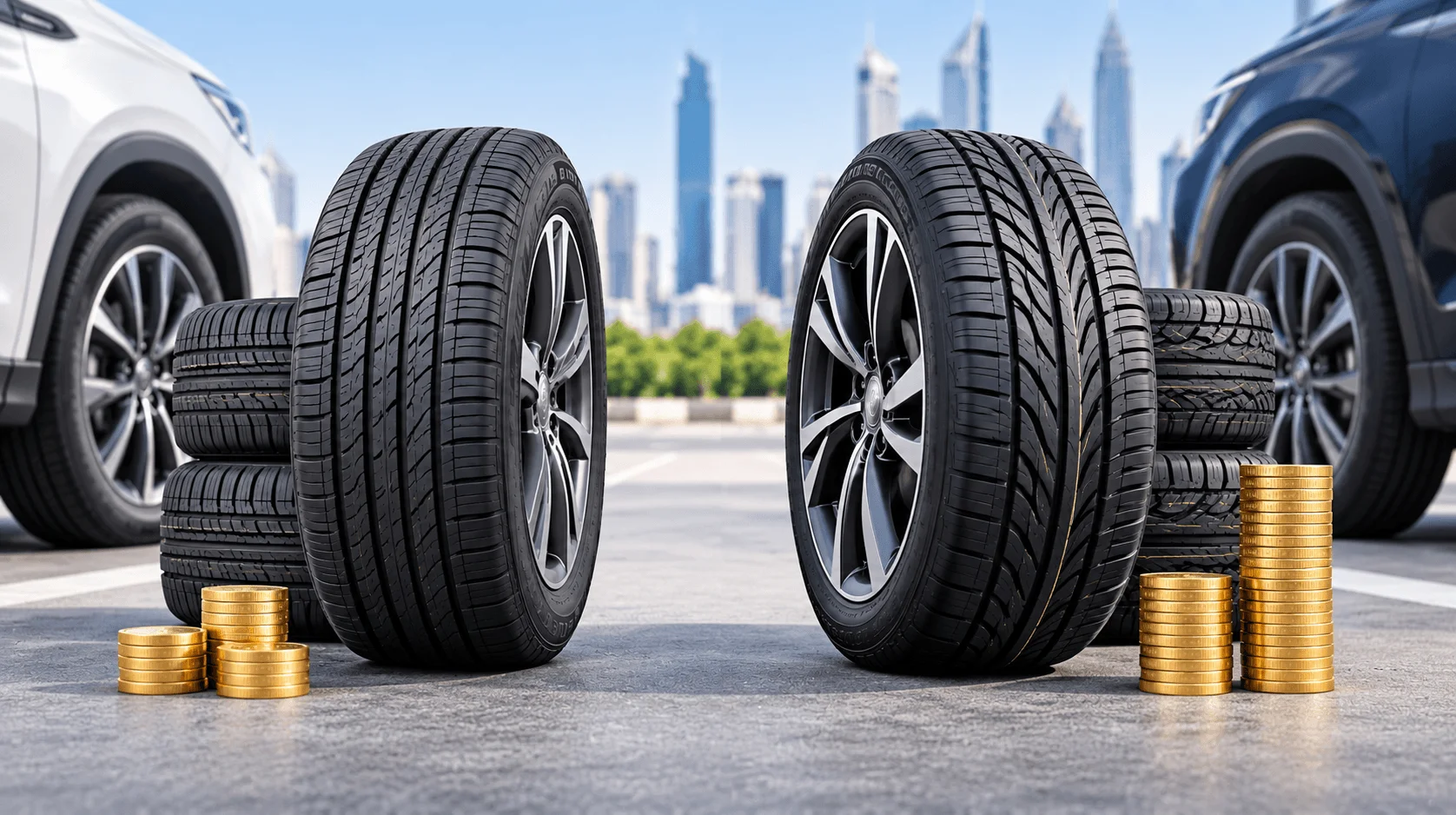
Two tyres can be exactly the same size and still have very different price tags. That is because tyre size describes the tyre’s dimensions; it does not tell you about its rubber compound, internal construction, braking performance, noise characteristics, development or warranty.
When comparing budget vs premium tyres, do not assume that two tyres marked 205/55 R16 will perform the same simply because they fit the same wheel.
A tyre size such as 205/55 R16 identifies its width, aspect ratio, radial construction and wheel diameter. However, two tyres with the same dimensions can still have different load indices, speed ratings, compounds, tread designs and performance characteristics. Michelin notes that tyres of the same size can carry different load and speed ratings.
Load index is the numerical code indicating the maximum load a tyre can support under specified conditions, while speed rating indicates its maximum rated speed under specified load conditions. Several factors explain the difference in tyre prices.
Tyre compounds influence characteristics including grip, wear, rolling resistance and heat management. Premium manufacturers often invest heavily in developing compounds that balance several performance requirements rather than maximising just one.
This does not mean every expensive tyre is automatically better than every budget tyre. The exact models still need to be compared.
Testing is also a major part of tyre development. Continental states that a new tyre can undergo up to 25 million kilometres of testing before production, while around 143,000 test tyres are evaluated annually at its Contidrom facility. These are Continental’s own development figures, but they illustrate the scale of testing that can sit behind a premium tyre.
Tread patterns are engineered around different priorities, including water evacuation, handling and road noise. Some premium tyres also use dedicated noise-reduction technologies or optimised tread patterns to improve cabin comfort.
Premium tyres can outperform lower-cost alternatives in particular tests, but performance should be compared model by model rather than assumed from price or brand category alone.
Continental’s own testing against lower-cost competitors reports advantages for its premium tyres in areas including wet braking, dry handling and noise. Because these results come from Continental’s testing, they should not be treated as evidence that every premium tyre will outperform every budget model.
Wet braking refers to a tyre’s ability to slow and stop the vehicle on a wet road. Wet-road behaviour is affected by rubber compound, tread pattern and tread depth remaining.
Drivers buying tyres in Dubai should not ignore wet performance simply because rainfall is less frequent than in some other markets.
Tyres influence steering response, cornering and vehicle stability. A driver using a powerful SUV or performance car may prioritise these characteristics more heavily than someone driving a small car mainly for short urban journeys.
Premium manufacturers may use tread design and noise-control technologies to reduce tyre-generated sound. However, actual cabin noise also depends on the vehicle, road surface, speed and tyre pressure.
No. A lower-priced tyre for a car is not automatically a poor tyre. A budget option can be suitable if it meets the vehicle manufacturer’s required tyre size, load index and speed rating and is appropriate for how the vehicle is used.
Michelin advises one to confirm these technical specifications when getting replacement tyres as even with the same size, a tyre may have different ratings.
The mistake is choosing solely because a tyre is cheap. A city car covering modest annual mileage has different requirements from a heavily used SUV or performance vehicle travelling long motorway distances.
No single best tyre brand in UAE suits every vehicle, budget and driving pattern. Price should be treated as one comparison factor rather than a performance rating.
A premium performance tyre may offer capabilities that a particular driver does not need, while the cheapest available tyre may involve compromises that matter to another driver. It is better to compare equivalent models that meet your vehicle’s specifications and driving requirements.
Before buying replacement tyres, check more than the number on the price tag:
A car tyre offer only represents good value when the tyre itself is appropriate for your vehicle.
Whenever possible, compare the fully fitted cost. A cheaper advertised tyre can become less attractive once fitting, balancing, valves or other charges are added.
Tire.ae states that its fully fitted prices include VAT, standard fitting, wheel balancing, a new standard rubber valve, delivery to the installer and disposal of old tyres. Its current terms also state that customers purchasing four tyres receive one scheduled tyre rotation every 10,000 km per year.
The right choice between budget and premium tyres depends on more than price. Start with your vehicle’s required specification, then compare performance, warranty and the total fitted cost.
Tire.ae offers multiple tyre brands and lets UAE drivers compare options by vehicle and tyre size. Its Dubai fitting locations include Al Quoz and Umm Ramool, making it easier to choose suitable tyres in Dubai and arrange professional fitting.
The cheapest or most expensive option isn't automatically the right tyre for your car. Compare the available options based on your vehicle, driving needs, and budget, then choose the tyre that gives you the right balance of performance and value.
Ready to replace your tyres? Compare budget and premium tyres on Tire.ae, choose the right fit for your car, and book your tyre fitting today.
Development, compounds, construction, testing, performance targets and additional technologies can all influence the final price.
A budget tyre can be suitable if it meets the required vehicle specifications and applicable standards and is correctly fitted, inflated and maintained.
They can be when their braking, handling, comfort, efficiency or durability characteristics match your driving requirements.
Tyres with identical dimensions can have different load and speed ratings, compounds, construction, tread technology, warranties and performance characteristics.
No. Compare the exact model and specification rather than choosing solely by manufacturer.
Not necessarily. Check the tyre specification, manufacturing details, warranty and final fitted price before deciding.